

HERBAL MEDICINE

Customized herbal medicine, tailored to you.
My skills as an herbalist are included in the price of acupuncture treatment. If you want an herbal formula, you will leave the office with one. The cost of herbs is additional.
I have been creating and prescribing herbal formulas since the 1990s. It’s a big part of my tool kit.

I did my schooling of Chinese medicine in California in the late 1990’s, where herbal medicine was a significant part of my training. It was also a part of almost every patient treatment I observed, and then performed myself in my supervised clinical internship in a busy Santa Cruz clinic. I learned about Chinese herbology using loose, raw herbs as seen in this photo. I would weigh them with the balance scale being used by the men in the picture, and assemble formulas in this same way. At home, patients would then cook the herbs in water, strain them, and drink the tea.
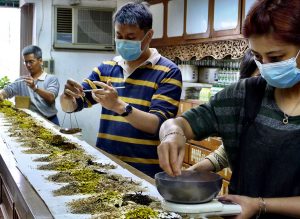
I took this picture in 2011, when I spent two weeks in Taipei, Taiwan, observing in the busy clinic of Dr. Lee Chen-Yr, a prominent practitioner of Chinese medicine
I do not stock a raw herb pharmacy as shown in this picture– it requires a great deal of space, and people typically don’t like the labor and smell involved in cooking the herbs at home. Instead, I utilize high quality herbs that have already been cooked in water, decocted, and then freeze-dried granulated. I decide which herbs will go into a patient’s formula, and then combine them together in the office while the patient is resting during their acupuncture treatment in a separate room. The patient leaves the office with a small bottle filled with a powder, a spoonful of which is put in a cup, and mixed with hot water to dissolve it before drinking it at home. Pre-made herbal formulas in pill form are also an option, and some formulas are available in tea bags.
What makes Chinese herbal medicine unique and so powerful
Each person is treated as unique and individual
One formula for a condition does not fit all. The appropriate formula is chosen based on the presentation of symptoms, which will be unique to each person. If herbs are taken for a more chronic condition, the formula will be modified over time, as the body presentation changes. It is this adaptability and specificity that makes herbal treatment so powerful and helpful.
Synergy
Instead of giving one herb to treat a condition, a dozen or more herbs are combined together in a formula. Using herbs in combination allows them to work synergistically to address symptoms, while also harmonizing and balancing the entire body. The more balanced a formula is, the less chance there is for further imbalance to occur, and the more effective it will be in treating the condition.
Safety Considerations
Expertise
Most states, including Washington, do not require acupuncturists to have training in herbal medicine. Yet many practitioners recommend and sell herbal products, and the consumer can freely purchase and self-prescribe herbs. The result can be ineffective, and worse, potentially unsafe herbal treatment. I received my master’s degree in traditional Chinese medicine from a school in California, where extensive training in herbal medicine is mandatory for licensure. I am also a nationally Board certified Chinese herbalist with more than two decades of clinical experience using herbs to help patients feel better and reach their health goals.
Herb Quality
Chinese herbs are dried berries, flowers, roots, stems, fungi, bark, seeds. I use no animal products. I think of Chinese herbs as some of the world’s most powerful superfoods, and I consume some each day. The pharmacology, chemical makeup, and effect on the body of each Chinese herb is known. I have about 200 different herbs in my office pharmacy. A formula typically has a dozen or so herbs in it.
Expectations
Interactions
Herbal Medicine

Experienced
I am a nationally Board certified herbalist with 20 years of clinical experience and an understanding of pharmaceutical medications and any possible interactions.

High Quality
Tremendous care is taken to source high-quality herbs that are extensively third-party tested and don’t use threatened species.

Effective
Herbal formula is customized and specific to the patient and modified over time to adapt to changes in the body, enhancing effectiveness.

Straightforward
Formula is provided as an easy-to-take liquid, or powdered tea, with clear instructions.
“Kristi is a wonderful practitioner: an insightful diagnostician, with gentle needling skills and an extensive understanding of Chinese herbs.
I have seen her for several years now and I refer my own patients to her as well. Each of us have valued and benefitted from her expertise. I always know when I refer my patients that they will be well cared for, just as I have.” — Krista H